![[ the teaching Lane ]](http://images.squarespace-cdn.com/content/v1/5ef46bed48f5ca64a75df7f8/f515f70d-8300-4ff2-93c4-841cd96d20e8/icon.png?format=1500w)
What are the right question to be asking?
Please write your article below:
What questions to ask? Questioning and discussion sit at the heart of teaching, one of the first skills we develop as practitioners until it becomes instinctive. That well timed pause in a lesson to check or clarify understanding when the flow of lesson is not going smoothly.
More often we are planning questions within lessons. Using them to gauge prior learning, activate recall or sign post to students that we are moving into another part of the lessons. This means that careful planning and selection of questioning is vital .
What questions to ask?
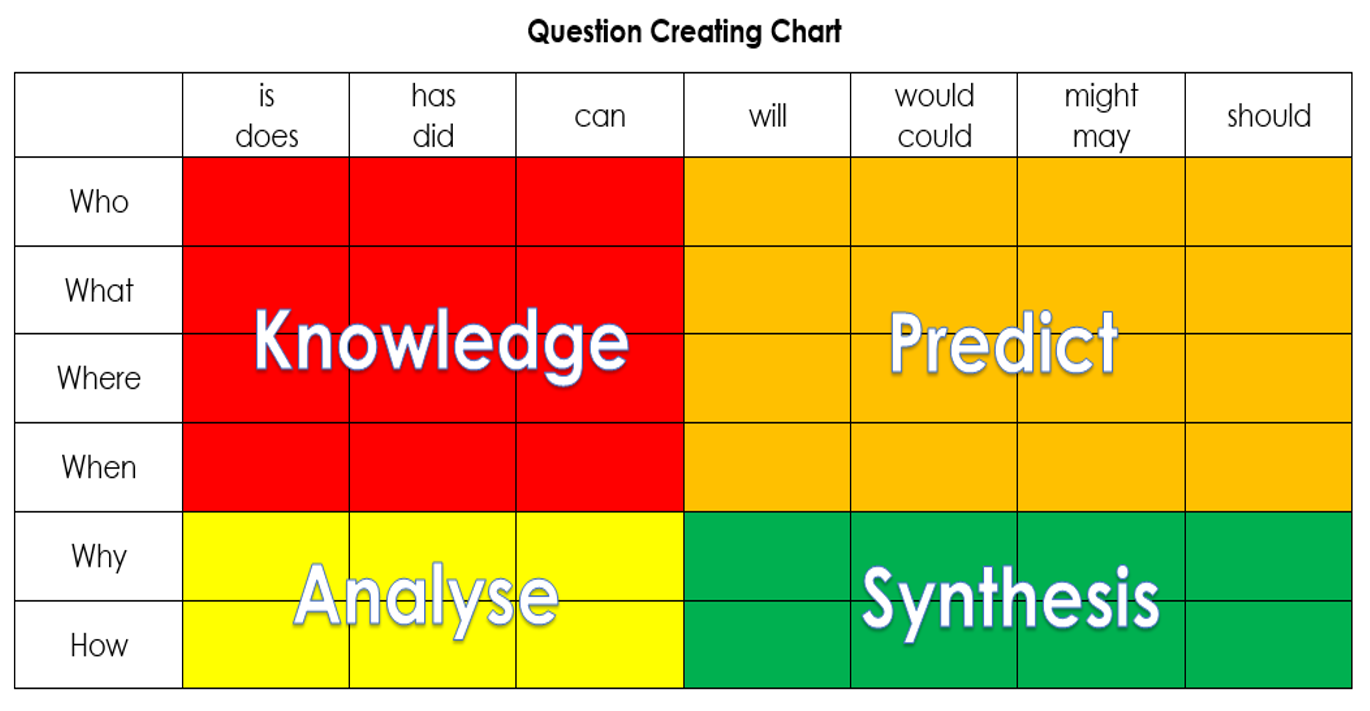
Question chart, Q-Chart or Q-Matrix. You may well have seen this tool online or in a CPD course (which is where I first encountered it) at some point in your teaching career. Developed by Chuck Wiederhold in the 1990s under the name of Q-matrix, it gives a structured approach to designing questions that grow in pitch and expectation. Questions compare event, situation, choices, person, reasons and means against if the subject is present, past, a possibility, a probability, a prediction or need imagination. The interactions between these themes can be grouped into the four themes or areas of knowledge, prediction, analysis and synthesis. Knowledge questions are the simplest and prompt knowledge retrieval or superficial retrieval from a source. Prediction questions, as you might have predicted encourage children to … predict from a source mixing prior learning with some reasoning. Analyse questions are where skills of inference are applied, especially those Why questions. The most challenging questions are formed from the synthesis section, with question openers such as “why will …” or “how might …”. Questions that need children to blend learning from multiple occasions to form an answer.
Why does this matter? Why put this much thought into planning questions? Firstly, it prompts us to consider if we are asking the question we mean to. Are we using suitable vocabulary within the instruction of the question so that all children understand what is being asked of them? I can certainly recall times when I have received some well considered and lengthy answers that are not really related to my question due to misunderstanding from my wording.
Planning with a tool like the Q-chart also prompts teachers to think about differentiation and progression. It can be easy to fall into the habit of, for example, using mostly retrieval style questions and not those that require prediction or synthesis. Oracy like this is a leveler, allowing all children regardless of reading or writing skill to engage in higher level thinking and debate. Even children at the beginning of Year 1 can begin to answer synthesis questions using their own personal experiences and the few RE lessons they may have had.
When to ask questions?
As with many parts of lessons (and the jokes we might chuck in) timing is everything. Do we always need to start a lesson with a closed knowledge retrieval question? It makes sense too, but sometimes we may really need students to grapple with a concept or use their imagination first. In my classroom, there is little religious or ethnic diversity so starting a unit with an open question draws out misconceptions and stereotypes in a non-judgmental nor pressured way. Synthesis questions direct children to engage with their personal worldview and compare this with prior learning, ensuring that they start a lesson on a solid and self-aware basis.
During lessons, we can progress through different Ways of Knowing with our questioning. I often start with questions or Belief (or Theology) drawing out the key concept from a sacred text or artifact being studied to capture what a person of that faith may take from it. The same question could then be reposed as a question of Thinking (or Philosophy) to broaden one religion’s idea into a broader scope. For example, we could first ask “What can a Christian learn about helping others from The Good Samaritan?” and then move on to ask “Why might it be important to help people in need?”. From these answers, we can then circle back asking question of Living (or the Social Sciences) “Where could a Christian put the message of the Good Samaritan into action?” or extend the same thread of learning into a second worldview asking “Where could a _____ help others in need?”
How does questioning build oracy?
When we plan questions carefully, we are modelling how to structure talk. These planned questions model the curiosity and precision in language that we need in pupils. This is where having a procedure for responding to a question is important. In my school we use the “Think, Pair, Share” approach from the Walkthrus series (Sherrington and Caviglioli, 2020), where time is given to thinking before turns are taken in sharing and then comparing answers within talk partners. Pupils can then share with the class and given (if needed) support to extend and justify their answer. Other children can then be called on to respond to the other’s ideas. Through this, we help pupils rehearse the habits of dialogue that underpin good oracy.
Providing stem sentences for answering can also be powerful. Starters such as “I agree because…”, “Another example might be…” or “I’m not sure, but perhaps…” show how we respond in turn. How we speak to and respond to each other rather than politely waiting our turns to talk at each other.
Why this matters in RE
Questioning remains one of the simplest and yet most complex tools we use. When linked with oracy, it becomes not just a way of checking understanding but a way of forming it. Each question we ask, and how we invite pupils to respond, shapes their ability to reason. It builds the skill of paying attention to each word and its content that is needed when we actively listen. Most importantly, pupils learn to articulate their ideas with respect and confidence. Pupils are learning through talk, not just talking about religion.
Thoughtful questioning sits at the center of what it means to teach RE well: creating a space for curiosity, respectful dialogue, and the shared search for meaning.